
Managing compliance risk isn’t just about avoiding penalties – it’s about protecting the business...

An effective employee retention strategy isn’t just about keeping people on payroll – it’s about building a business that people want to stay part of.
Yet for many organizations, retention continues to feel elusive. Turnover remains high. Morale feels fragile. Leadership cycles through new initiatives – updated benefits, engagement surveys or culture programs – only to see little lasting change.
The issue usually isn’t effort. It’s perspective.
Too often, employee retention strategies are treated as isolated HR initiatives instead of what they truly are: a reflection of how leadership, operations, culture and risk management work together. When retention is approached in silos, it fails. When it’s viewed holistically, it becomes a powerful driver of stability, resilience and long-term business value.
So, what does that look like in practice? To answer that, we need to break down why employee retention matters, where most strategies fall short and what it takes to build an approach that’s repeatable, measurable and actually lasts.
Why Employee Retention Strategy Matters More Than Most Businesses Realize
When employee retention becomes a concern, cost is usually the first thing leaders notice – and for good reason. Replacing an employee costs on average six to nine months of that employee’s salary, before factoring in recruiting, onboarding, training and lost productivity.
But for many organizations, the financial impact is only the most visible part of the problem.
The deeper effects of turnover show up in day-to-day operations. Teams lose continuity. Managers are pulled away from leadership and into constant hiring. Remaining employees absorb extra work, which slows productivity and accelerates burnout. Over time, this instability wears down the workforce while quietly affecting customer experience, quality and trust.
And it doesn’t stop there. Inconsistent training, inexperienced workers, and process breakdowns increase the likelihood of safety incidents, compliance gaps and claims activity. These patterns put employees at risk and raise red flags for insurers, lenders and partners. What begins as a staffing challenge can quietly escalate into a broader business risk.
This is where employee retention strategy begins to matter at a much higher level. Retention isn’t just about keeping people – it’s about maintaining operational consistency, controlling risk and building long-term resilience across the business.
What an Employee Retention Strategy Really Is (and Why Most Get It Wrong)
Despite how much employee retention strategy influences cost, risk and long-term stability, many organizations still approach it with too narrow a lens. They fundamentally misunderstand what actually drives retention.
Because of that misunderstanding, retention efforts tend to focus on what’s most visible and easiest to measure. Competitive pay, surface-level perks, annual engagement surveys or one-off culture initiatives become the default response. These efforts aren’t wrong – but they’re incomplete. They react to turnover after it happens instead of addressing the conditions that lead employees to disengage or leave in the first place.
The problem is that a true employee retention strategy isn’t a program. It’s a system – one that reflects how the business actually operates.
Retention is shaped by how leadership communicates; how work is structured; how decisions are made under pressure; and whether employees feel supported, developed and valued over time. It’s influenced by safety practices, benefits design, workload expectations and management consistency.
To put it simply: retention doesn’t live in one department – it shows up everywhere.
That’s why so many employee retention strategies fail. Employees rarely leave for a single reason. They leave because of accumulated friction: unclear expectations, inconsistent leadership, limited growth, chronic burnout or feeling unseen. Over time, those signals outweigh even the strongest compensation or benefits.
That’s why, when retention is approached holistically, those patterns become easier to recognize – and easier to correct.
How to Build an Employee Retention Strategy That Actually Works
A sustainable employee retention strategy isn’t built through a single initiative. It’s built by strengthening the systems that shape the employee experience day to day.
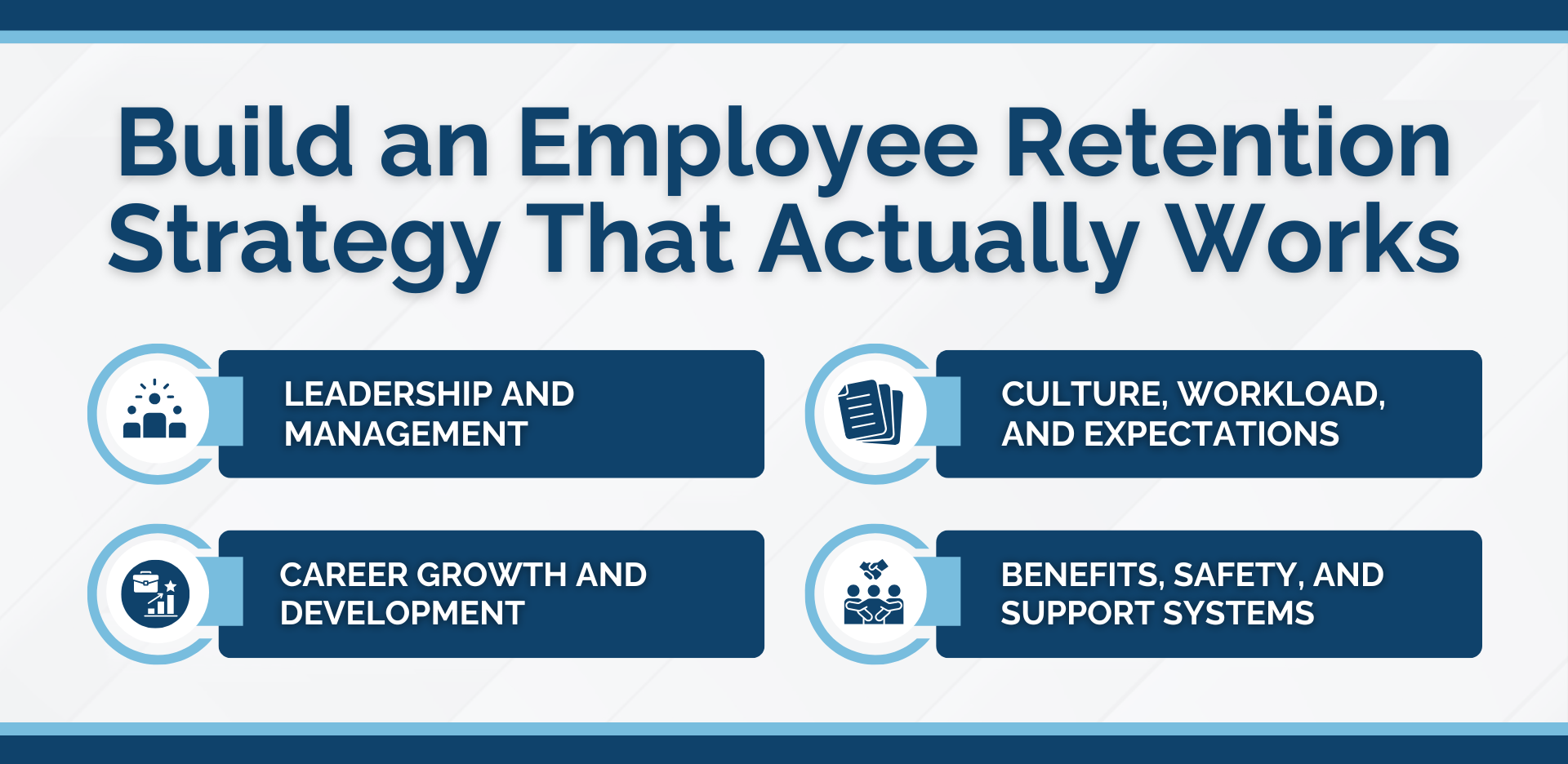
The most effective employee retention strategies tend to focus on a few core areas.
Leadership and Management
Leadership is one of the strongest predictors of employee retention strategy success. You’ve probably heard it before – employees don’t leave companies, they leave managers.
Clear expectations, consistent communication and regular feedback create stability. When managers are equipped to lead – not just oversee – employees feel supported and confident in their roles. Without strong leadership, even the best-designed retention efforts struggle to gain traction.
Career Growth and Development
An effective employee retention strategy makes the future visible.
Employees want to understand how they can grow, contribute and progress within the organization. Clear development paths, skill-building opportunities, mentorship and internal mobility signal long-term investment. When employees can see where they’re going, commitment tends to follow.
Let’s say you run an electrical contractor and you take on an apprentice. Are you helping with the cost of their classroom schooling? Do they know what the path looks like to becoming a journeyman in the organization, including the classroom requirements, on-job training and time in the field to earn that designation?
Once they become a journeyman, what’s the next step? Project manager? Crew foreman? How many years before that becomes a realistic possibility?
Finally, if someone advances to the top positions, what incentives are you offering for continued growth and leadership? Employee ownership stake? Exclusive executive benefits?
When you make the path forward extremely clear, your team members are encouraged to stick it out through rough paths – because there is a always the light at the end of the tunnel.
Culture, Workload, and Expectations
Culture can make or break an employee’s experience – and the numbers back it up. Data on U.S. workers shows that “Engagement and Culture” and “Well-being and Work-Life Balance” accounted for 68% of all voluntary employee departures in 2024.
This is why a realistic employee retention strategy accounts for workload balance, clear priorities and respect for employee time. Chronic overwork, unclear role or constant reactivity slowly erode engagement.
Organizations that set achievable expectations and support sustainable performance create environments where employees can stay – and succeed – long term.
Benefits, Safety, and Support Systems
Benefits and safety are foundational elements of employee retention strategy.
Thoughtfully designed benefits, consistent safety practices, and reliable support systems help employees feel protected and valued. When safety is treated as a core value and benefits align with real employee needs, trust grows. That trust plays a meaningful role in whether employees choose to stay.
Employee Retention Strategy as a Business Value Strategy
An employee retention strategy isn’t a standalone initiative. It’s a reflection of how the business is built.
When leadership, operations, safety, benefits and risk management are aligned, retention improves naturally. When they aren’t, turnover is often the first visible sign that something deeper is misaligned.
This is where a holistic approach matters.
At Ellerbrock-Norris, that holistic perspective guides everything we do. We help businesses align employee strategy with areas like safety, benefits, insurance, compliance and leadership structure so retention improves while risk exposure decreases. The result is a stronger, more resilient organization built for long-term value – not short-term fixes.
If your employee retention strategy feels fragmented, or if turnover is creating ripple effects across your business, it may be time to look at the full picture. We help organizations do exactly that.
If you’re ready to approach employee retention that’s measurable, repeatable and as part of a more resilient business strategy, we’re here to help.