


Whether you run a construction business, distribution facility, restaurant franchise, dental...
Nuclear verdicts are becoming increasingly common, and they’re reshaping the environment contractors and trades businesses operate in.
You see the effects everywhere – rising insurance costs, tighter underwriting and growing expectations around documentation and safety. And when a serious incident does happen, these verdicts can turn a routine claim into something far more severe. But here’s the encouraging part: you’re not powerless in this landscape. A holistic approach to risk management gives you influence on both sides of the equation – the likelihood that your own claims will ever escalate, and the current insurance environment you’re navigating.
Understanding what nuclear verdicts are, why they’re happening and where your business has control is the first step in protecting yourself long before a courtroom is ever involved.
What are Nuclear Verdicts?
A nuclear verdict is any jury award that exceeds $10 million. That number alone is significant, but the real shift is how common these verdicts have become.
In 2023, juries issued 89 nuclear verdicts – a 15-year high totaling $14.5 billion across nearly 50 industries. Many stemmed from everyday risks like vehicle incidents, product liability claims and allegations of negligence.
In other words, this isn’t a rare event anymore – it’s a trend.
But the rise of nuclear verdicts isn’t just about the size of the awards; it’s about the environment behind them. Juries today expect more from businesses, and when they feel a company didn’t meet that mark, verdicts climb fast. Attorneys understand that shift and lean into it. Trial tactics like reptile theory and jury anchoring tap into instinct and emotion rather than fact, often pushing outcomes far beyond what anyone anticipated.
Third-party litigation funding adds even more fuel. With outside investors financing lawsuits, plaintiffs have the resources to pursue longer, more aggressive cases – giving claims more room to escalate.
Together, these forces are driving nuclear verdicts to appear more often and in places many business owners never expected to see them. And that rise has real implications for everyday businesses – whether they ever see a courtroom or not.
How Nuclear Verdicts Influence All Areas of Business
Even if you’ve never stepped foot in a courtroom, nuclear verdicts matter for three major reasons.
1. Any business could find itself in a nuclear verdict situation
With litigation on the rise, incidents that once led to moderate claims now have the potential to escalate into something catastrophic. Vehicle accidents, subcontractor injuries, product issues or employee allegations can quickly turn into cases where juries are looking for accountability and evidence of responsible leadership.
2. Nuclear verdicts have raised expectations for how businesses operate
Across industries, the bar is higher. Juries expect more. Regulators expect more. Underwriters expect more – not only in how you operate, but in how consistently you can prove it.
3. Nuclear verdicts push insurance costs upward for everyone
As claim severity increases, insurers respond by tightening their standards. That means higher premiums, stricter underwriting and reduced carrier appetite even for businesses with clean loss histories.
The through line:
You can’t control when nuclear verdicts happen in the world around you, but you can control how prepared your business is – both in how a claim unfolds and how your insurance is priced.
How to Reduce Your Nuclear Verdict Exposure
Now that you have a clearer picture of nuclear verdicts and how they influence your insurance costs, let’s focus on what you can actually control.
Here’s the part many business owners don’t realize: improving one area protects you on both sides. The same consistent, well-documented processes that reduce your nuclear verdict exposure also strengthen your insurance position. When you get proactive and shore up these operational areas, you’re not just preventing a claim from escalating – you’re shaping how insurers perceive your business long before renewal.
Credibility matters in both arenas. When your business reflects clear standards, dependable follow-through and proactive leadership, it becomes much harder for a claim to spiral into nuclear territory or for an underwriter to view you as a high-risk account.
Here are some of the areas that matter most:
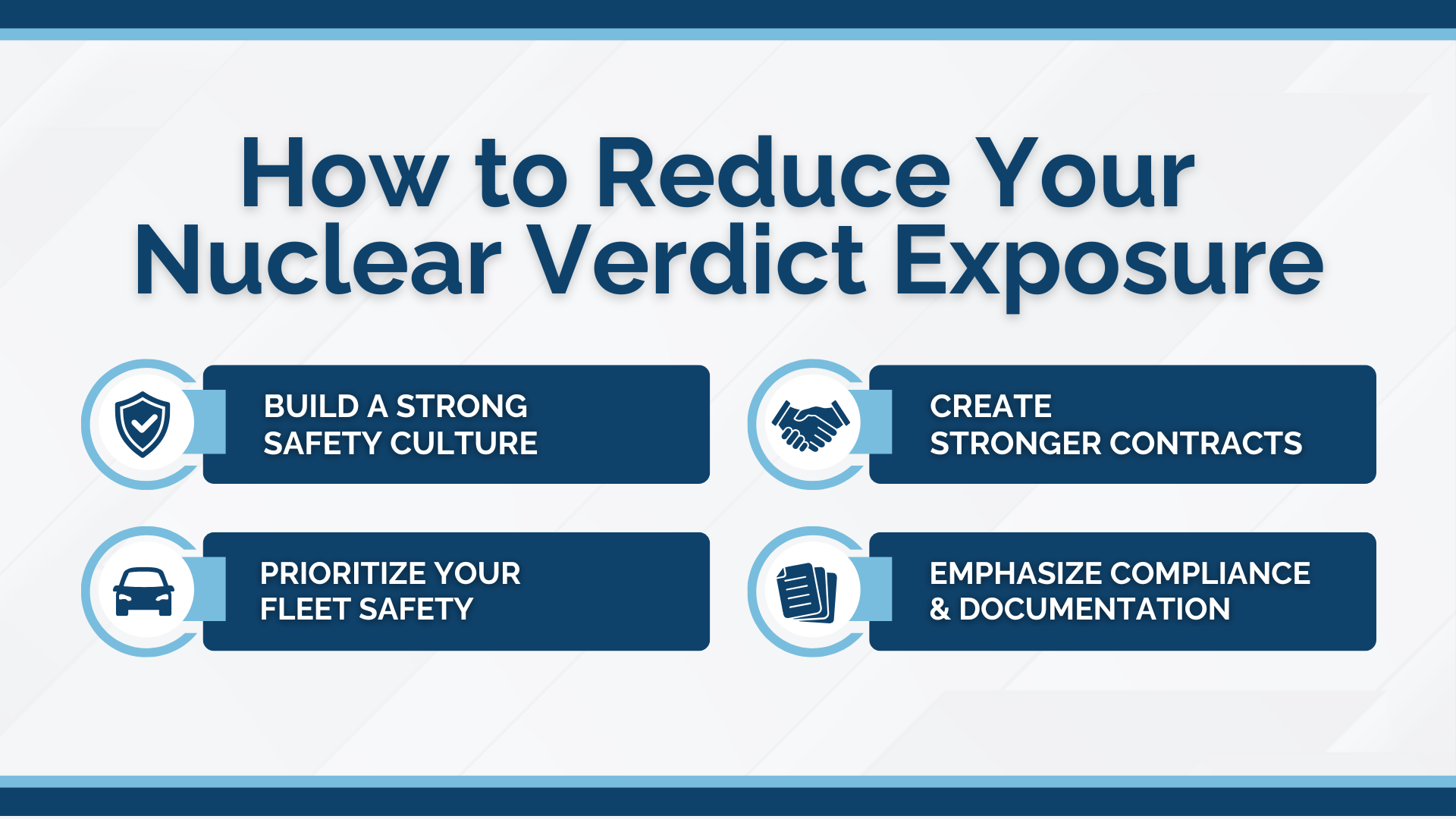
A Strong Safety Culture
A safety program that’s written down, reinforced and actually lived out doesn’t just protect people. It demonstrates that your organization values its workers.
Many nuclear verdicts begin with accusations that a company ignored warning signs or failed to correct known issues. Clear procedures and documented follow-through help shut down that narrative before it gains momentum.
Discover our four steps to creating a culture of safety in your business.
Fleet Safety
Auto liability remains one of the most common sources of nuclear verdicts, which makes fleet oversight a critical part of your defense.
Driver policies, telematics, dashcams and regular maintenance aren’t just operational tasks – they’re tangible proof that your company takes safety seriously. In a nuclear verdict environment, that proof matters.
Interested in telematics but not sure how to introduce them into your business? We’ve got you covered on the dos and don’ts.
Stronger Contracts
Contracts quietly shape where liability lands. When scopes of work are vague or subcontractor insurance requirements aren’t enforced, you can inherit risks you never intended to take on.
Clear responsibilities and solid indemnification language help ensure your business isn’t absorbing unnecessary nuclear verdict exposure.
Compliance and Documentation Shape the Story in Court
OSHA, DOT, HR and wage-and-hour requirements aren’t just regulatory hurdles. Inconsistent documentation or missed steps in these areas can be used in court to paint a narrative of carelessness.
A single violation can become a powerful accusation. A strong focus on compliance and a pattern of consistent follow-through help prevent that narrative from taking root.
How Ellerbrock-Norris Helps You Build a Stronger Defense Against Nuclear Verdicts
Nuclear verdicts aren’t just about insurance. They’re about leadership, consistency and the daily decisions that shape a company’s culture and credibility. At Ellerbrock-Norris, we help businesses build the structure behind those decisions.
Through ENCORE, our Comprehensive Ongoing Risk Evaluation, we look across 10 key impact areas – safety, business continuity, contracts, compliance, operations and more – to identify where your vulnerabilities truly are.
But we don’t stop at pointing them out. We help you fix them. We work with you to build better documentation, reinforce safety, update contracts, and strengthen all areas that directly influence claim outcomes and underwriting decisions.
When renewal season arrives, your submission isn’t just a packet of documents. It reflects a year of strategy, improvement and proof – exactly what carriers want to see and exactly what juries consider if something ever goes wrong.
That’s the power of being proactive in a world with nuclear verdicts. You’re not waiting for a claim to test your systems. You’re strengthening the systems long before they’re ever challenged.
Ready to begin protecting your business and your purpose? Let’s chat.
.png?height=200&name=Blog%20Image%20(8).png)
.png?height=200&name=Blog%20Image%20(3).png)