
Whether you run a construction business, distribution facility, restaurant franchise, dental...

Subcontractor default insurance doesn’t usually come up when a job is running smoothly.
But experienced general contractors know risk doesn’t always start loud. It shows up quietly – when a subcontractor falls behind, misses payments or struggles to keep pace with the work. And with 72% of construction projects now facing delays tied to labor and subcontractor shortages, those early warning signs are becoming more common. By the time the default is official, the project is already feeling the impact: stalled progress, rework, rising costs and strained relationships.
Subcontractor default insurance helps contractors take control in these moments. Not just by offering financial coverage, but by giving you the authority to act quickly, make the call and keep the job moving without waiting on third parties.
Understanding how it works – and where it fits – can be the difference between disruption and resilience.
How Subcontractor Default Insurance Works
Subcontractor default insurance is a first-party insurance product. That means the general contractor – not the owner or the subcontractor – is the one who buys it, manages it and gets reimbursed when something goes wrong.
If a subcontractor defaults because they walk off the job, fall behind deadlines or deliver poor work – the general contractor decides when to declare the default and triggers the policy. Unlike performance bonds, which involve lengthy third-party investigations, SDI allows the contractor to act fast: hire a replacement sub, fix the work and keep the job moving.
That control comes with shared responsibility, though.
You’ll need to pay a significant deductible (often called a self-insured retention), along with a percentage of the costs up to a certain limit. After that, the policy kicks in to help cover not just the direct cost of fixing the problem, but also the ripple effects like project delays or extended overhead.
Who Subcontractor Default Insurance Is For
Subcontractor default insurance isn’t the right fit for every contractor.
Most insurers won’t offer it unless you’re managing at least $50–100 million in annual subcontract volume – and you have strong internal systems for vetting and overseeing your subs.
That’s because with subcontractor default insurance, the responsibility shifts to you.
The insurer isn’t stepping in to run the process – you are. That includes:
- Running a pre-qualification program
- Evaluating financials, safety records and past performance
- Tracking risk indicators across your subcontractor base
- Deciding when a default is serious enough to trigger the policy
- Managing the documentation, claims process and resolution
It’s a heavy lift and it’s why subcontractor default insurance tends to be a better fit for general contractors and construction managers already operating at scale with tight internal controls.
What Subcontractor Default Insurance Covers – and What It Doesn’t
Before you count on subcontractor default insurance to get you through a tough situation, it’s important to understand what is actually covered.
A typical subcontractor default insurance policy covers:
- The cost to complete the defaulted subcontractor’s scope of work
- Rework required to fix defective or poor-quality construction
- Delay-related damages, like acceleration costs and extended overhead
- Legal and professional expenses tied to resolving the default
A typical subcontractor default insurance policy does NOT cover:
- High deductibles and copays: Most policies include a self-insured retention between $350K and $2M, plus a 10–20% copay.
- Every subcontractor: Some policies exclude certain trades or cap coverage based on subcontractor type.
- Protection for subcontractors: Subcontractor default insurance is designed to protect the general contractor, not the subcontractor. If the general contractor defaults, the sub doesn’t have coverage under this policy.
These gaps are why many contractors pair subcontractor default insurance with clear contract protections like waivers of subrogation.
The Benefits of Subcontractor Default Insurance
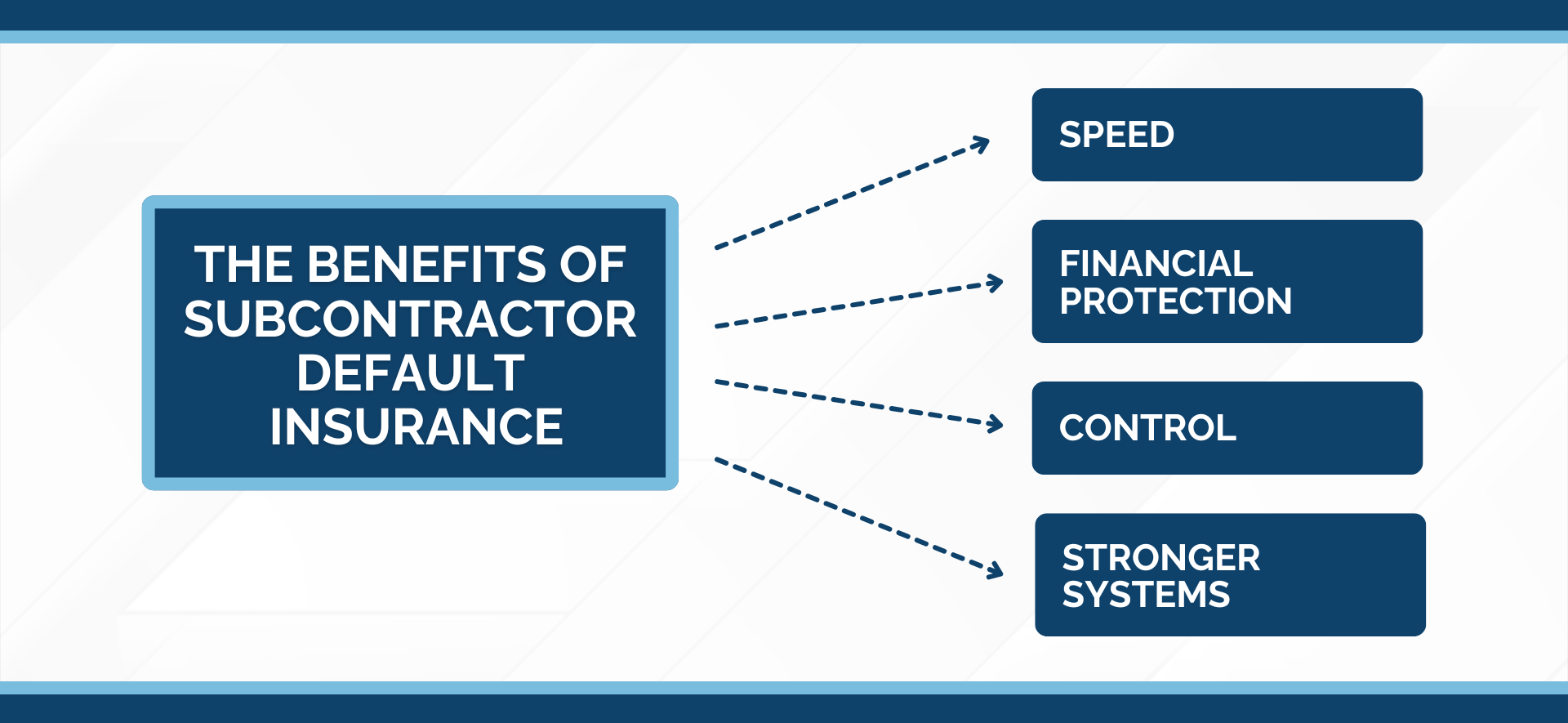
Once you understand how subcontractor default insurance works – and what it actually covers – the upside starts to come into focus:
- Speed: You control the claims process and don’t have to wait around for a third party to investigate or sign off.
- Control: You stay in the driver’s seat when it comes to timelines, replacements and how the recovery is handled.
- Financial protection: Subcontractor default insurance can help offset both the immediate and downstream costs that come with a subcontractor default.
- Stronger systems – Because you’re responsible for vetting and oversight, subcontractor default insurance naturally pushes you to tighten how you manage subcontractors.
At its best, subcontractor default insurance doesn’t just help you recover – it helps you reduce the chances of default in the first place.
Build a Plan That Holds – Not Just a Policy That Pays
Subcontractor default insurance is a powerful tool – but it isn’t the whole solution. It works best when it’s part of a broader risk strategy that connects the dots between your people, your operations, your contracts and the long-term value you’re building.
Because when a default happens, the financial impact is only part of the story. The real damage shows up in stalled momentum, strained relationships and lost trust. If your systems aren’t built to absorb that pressure, a policy alone won’t be enough.
At Ellerbrock-Norris, we help construction leaders stop reacting to risk and start planning around it. Our process looks at how risk actually moves through your business – from how you choose subcontractors to how you manage scheduling, communication, documentation and contract obligations. We identify the pressure points long before they turn into problems and build a plan that strengthens your operations, not just your insurance portfolio.
That’s what holistic risk management means. It’s practical. It’s proactive. And it gives you the confidence that when something does go wrong, your systems won’t crack under the weight of it.
If you’re navigating rising costs, tighter timelines and growing uncertainty around subcontractor performance, we can help you build a plan that’s ready before things go sideways.
Ready to take control before disruption hits? Let’s build a risk strategy that goes beyond coverage.